The following are the basic heat transfer calculation formulas for conduction, convection, and radiation:
Conduction Heat Transfer
Conduction is the transfer of heat through a material due to a temperature gradient within the material itself.
Fourier Law of Conduction
- The rate of heat transfer through conduction is given by Fourier’s Law:
Q = KA (T1 -T2)/ΔX
- Q is the rate of heat transferred through the surface (W or J/S)
- K is the thermal conductivity of the material (W/m-K)
- A is an area of the surface (m^2) normal to heat transfer direction
- T2 is the temperature of the hot surface (K)
- T1 is the temperature of the cold surface (K)
- Δx is the thickness of the material (m)
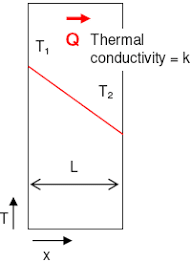
Determination of Conduction Rate
- For multilayer conduction heat transfer
- Thermal resistance, R = Δx/KA
- The total thermal resistance (RTotal) of a multilayer system is the sum of the individual thermal resistances. For a series arrangement of layers, the formula is:
Rtotal = R1 + R2 + R3 + ….. + Rn
- Where R1, R2, and R3 are the thermal resistances of the individual layers. Each layer’s thermal resistance (Ri)) can be calculated using the formula
- Determine the overall heat transfer rate (Q) through the multilayer system using:
Q = Overall Temperature Difference/Total thermal resistance
Q = ΔT /Rtotal
- Where ΔT is the overall Temperature difference across the multilayer system.
- Please note that this method assumes
- steady-state conditions
- and uniform material properties
- One-dimensional heat transfer through the layers.
- Real-world applications may involve more complex geometries and material properties that might require more sophisticated models or numerical methods for accurate analysis.
Convection Heat Transfer
- Convection is the transfer of heat between a surface and a fluid (liquid or gas) flowing over it.
- The convective heat transfer rate is commonly calculated using Newton’s Law of Cooling
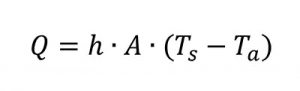
- Q is the convective rate of heat transfer (J/S)
- h is the heat transfer coefficient (W/m^2-K)
- C is the specific heat capacity of the fluid (J/kg-K)
- A is area of the surface (m^2)
- Ts is the surface temperature of the hot surface (K)
- Tf is the temperature of the flowing fluid (K)
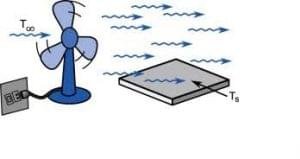
Calculation of Total Heat Transfer from Composite Wall
- Input Data
- Surface Area, A (m2)
- Thermal conductivities of materials, K (w/m-k)
- Heat Transfer coefficients of fluid on both sides of composite walls
- Temperature of fluids
- Calculate overall thermal resistance, Rth
- Calculate overall heat transfer coefficients, U (w/m2-k)

- Calculate heat transfer per unit area, heat flux (q,w/m2)
- Calculate total heat
- Refer to the following spread for calculations
Radiation Heat Transfer
- Radiation is the transfer of heat through electromagnetic waves.
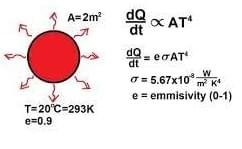
- The rate of heat transfer through radiation between two surfaces is given by the Stefan-Boltzmann Law:
Q = σ A (T2^4 – T1^4)
where
- Q is the radiative heat transferred (W or J/S)
- σ is the constant of Stefan-Boltzmann (5.67 x 10^-8 W/m^2-K^4)
- A is area of the surface (m^2)
- T2 is the temperature of the hot surface (K)
- T1 is the temperature of the cold surface (K)
These formulas can be used to calculate the heat transfer rate between two surfaces or to calculate the temperature of a surface after a certain amount of time.
Heat Transfer Coefficient Table for Engineering Applications
Here is a general heat transfer coefficient table (in W/m²·K) for various engineering applications, categorized by heat transfer mode:
1. Conduction (Solids)
| Material | Heat Transfer Coefficient (W/m²·K) |
|---|---|
| Copper | 50,000 – 100,000 |
| Aluminum | 5,000 – 20,000 |
| Steel | 2,000 – 5,000 |
| Brick | 200 – 500 |
| Wood | 5 – 30 |
2. Natural Convection
| Medium & Condition | Heat Transfer Coefficient (W/m²·K) |
|---|---|
| Air (free convection) | 5 – 25 |
| Water (free convection) | 100 – 1,000 |
3. Forced Convection
| Fluid & Flow Condition | Heat Transfer Coefficient (W/m²·K) |
|---|---|
| Air (low velocity) | 10 – 100 |
| Air (high velocity) | 100 – 1,000 |
| Water (low velocity) | 300 – 3,000 |
| Water (high velocity) | 3,000 – 10,000 |
| Steam Condensation | 5,000 – 100,000 |
4. Boiling & Condensation
| Process | Heat Transfer Coefficient (W/m²·K) |
|---|---|
| Water boiling | 2,500 – 100,000 |
| Steam condensation on water-cooled surface | 5,000 – 100,000 |
5. Radiation Heat Transfer
| Surface Condition | Heat Transfer Coefficient (W/m²·K) |
|---|---|
| Dull, oxidized surfaces (low emissivity) | 2 – 10 |
| Polished metal surfaces (very low emissivity) | 1 – 5 |
| Blackbody radiation (high emissivity) | 5 – 50 |
These values are approximate and vary depending on material properties, flow conditions, and system design. Let me know if you need a more specific table for a particular engineering application!
Thermal Conductivity Table for materials
Thermal Conductivity Table for Engineering Materials
Thermal conductivity (k) is measured in W/m·K and varies based on temperature and material purity. Here is a table of common engineering materials:
1. Metals (High Conductivity)
| Material | Thermal Conductivity (W/m·K) |
|---|---|
| Silver | 429 |
| Copper | 385 |
| Gold | 317 |
| Aluminum | 205 |
| Brass | 109 |
| Steel (Carbon) | 45 – 60 |
| Stainless Steel | 14 – 30 |
| Cast Iron | 50 – 80 |
2. Non-Metals (Moderate to Low Conductivity)
| Material | Thermal Conductivity (W/m·K) |
|---|---|
| Glass | 0.8 – 1.4 |
| Concrete | 0.8 – 1.5 |
| Brick | 0.7 – 1.0 |
| Rubber | 0.1 – 0.2 |
| Wood (Softwood) | 0.1 – 0.2 |
| Wood (Hardwood) | 0.2 – 0.4 |
3. Polymers (Very Low Conductivity)
| Material | Thermal Conductivity (W/m·K) |
|---|---|
| Polyethylene | 0.4 – 0.5 |
| Polypropylene | 0.1 – 0.2 |
| PVC | 0.12 – 0.25 |
| Teflon (PTFE) | 0.25 |
4. Insulating Materials (Ultra-Low Conductivity)
| Material | Thermal Conductivity (W/m·K) |
|---|---|
| Air | 0.024 |
| Water | 0.58 |
| Styrofoam | 0.03 – 0.04 |
| Fiberglass | 0.03 – 0.05 |
| Aerogel | 0.013 – 0.03 |
These values are approximate and can vary with temperature and composition. Let me know if you need values for a specific material or operating condition
Thermal conductivity table for firebricks, ceramics fibers, insulation in furnaces
Here is a table of thermal conductivity values for materials commonly used in furnaces, firebricks, ceramic fibers, and insulation:
1. Firebricks (Refractory Bricks)
| Material | Thermal Conductivity (W/m·K) |
|---|---|
| Standard Firebrick (Soft) | 0.8 – 1.3 |
| High-Alumina Firebrick | 1.5 – 2.5 |
| Insulating Firebrick | 0.2 – 0.4 |
| Dense Firebrick (Hard) | 1.5 – 3.0 |
2. Ceramic Fibers (High-Temperature Insulation)
| Material | Thermal Conductivity (W/m·K) |
|---|---|
| Ceramic Fiber Blanket | 0.05 – 0.15 |
| Ceramic Fiber Board | 0.1 – 0.3 |
| Refractory Ceramic Fiber | 0.1 – 0.2 |
3. Furnace Insulations
| Material | Thermal Conductivity (W/m·K) |
|---|---|
| Mineral Wool (Rock Wool) | 0.035 – 0.045 |
| Glass Wool Insulation | 0.035 – 0.045 |
| Calcium Silicate Insulation | 0.06 – 0.09 |
| Perlite Insulation | 0.03 – 0.05 |
| Vermiculite Insulation | 0.04 – 0.06 |
4. Other Furnace Materials
| Material | Thermal Conductivity (W/m·K) |
|---|---|
| Magnesite (Refractory) | 3.5 – 5.0 |
| Zirconia (Refractory) | 2.0 – 3.0 |
| Silica (Refractory) | 1.3 – 2.0 |
| Fireclay (Refractory) | 1.0 – 1.5 |
Summary of Key Materials for Furnace Insulation:
- Firebricks: These range from 0.8 to 3 W/m·K depending on whether they are dense or insulating.
- Ceramic Fibers: Excellent for high-temperature applications, with low thermal conductivity (0.05 – 0.3 W/m·K).
- Insulating Materials: Materials like mineral wool and glass wool are typically used in furnace insulation due to their very low thermal conductivity (around 0.035 – 0.045 W/m·K).