Properties of Steam
- Saturated steam properties — enter pressure or temperature, get Tsat/Psat, vf, vg, hf, hg, hfg, sf, sg
- Superheated steam properties — enter pressure + temperature, get interpolated enthalpy
- Dryness fraction (wet steam) calculator — enter pressure/temperature + known enthalpy, get quality x, or enter x to get mixture properties
The data is built from standard steam-table reference values with linear/bilinear interpolation between table points — good for practical engineering estimates.
Calculation of Steam Properties at Saturated T and P
- Steam tables are one of the most important references used in boiler design, thermal engineering, power plants, process industries, and energy audits. They provide the thermodynamic properties of water and steam at different pressures and temperatures.
- For a given saturated pressure, the corresponding saturation temperature and other steam properties can be obtained from the saturated steam tables. Similarly, when the saturation temperature is known, the corresponding saturation pressure and steam properties can be determined.
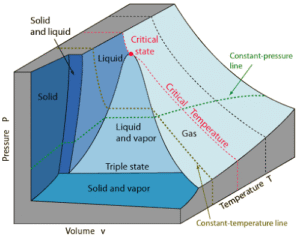
1. What Is Saturated Steam?
Saturated steam is steam that exists at the saturation temperature corresponding to its pressure. At this condition, water and steam can coexist in equilibrium.
For example, approximately:
| Saturation Pressure | Saturation Temperature |
|---|---|
| 1 bar(a) | 99.6 °C |
| 2 bar(a) | 120.2 °C |
| 5 bar(a) | 151.8 °C |
| 10 bar(a) | 179.9 °C |
| 20 bar(a) | 212.4 °C |
| 40 bar(a) | 250.4 °C |
| 60 bar(a) | 275.6 °C |
| 100 bar(a) | 311.0 °C |
Values are approximate; engineering calculations should use the applicable steam table/standard.
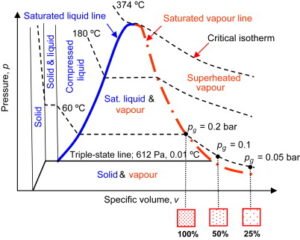
Important Steam Properties
The main properties normally obtained from steam tables are:
- Saturation temperature, Tsat
- Specific volume, vv
- Specific enthalpy, hh
- Specific entropy, ss
- Internal energy, uu
For saturated water and saturated steam, the following notation is commonly used:
| Symbol | Description |
|---|---|
| hfh_f | Enthalpy of saturated water |
| hfgh_{fg} | Latent heat of vaporization |
| hgh_g | Enthalpy of saturated steam |
| sfs_f | Entropy of saturated water |
| sfgs_{fg} | Entropy of vaporization |
| sgs_g | Entropy of saturated steam |
| vfv_f | Specific volume of saturated water |
| vgv_g | Specific volume of saturated steam |
| ufu_f | Internal energy of saturated water |
| ugu_g | Internal energy of saturated steam |
The relationships are:
hg=hf+hfgh_g
. Calculation When Saturated Pressure Is Given
Suppose the saturated steam pressure is:
P=10 bar(a)P=10\;bar(a)
Step 1 – Find saturation temperature
From the saturated steam pressure table:
P=10 bar(a)P=10\;bar(a)
corresponds approximately to:
Tsat=179.9∘CT_{sat}=179.9^\circ C
Therefore, the steam temperature at saturation is approximately 180°C.
Step 2 – Read steam properties from the table
At 10 bar(a), the saturated steam table gives approximately:
| Property | Symbol | Approximate value |
|---|---|---|
| Saturation temperature | TsatT_{sat} | 179.9 °C |
| Enthalpy of saturated water | hfh_f | 763 kJ/kg |
| Latent heat | hfgh_{fg} | 2,014 kJ/kg |
| Enthalpy of saturated steam | hgh_g | 2,777 kJ/kg |
| Entropy of saturated water | sfs_f | 2.14 kJ/kg·K |
| Entropy of saturated steam | sgs_g | 6.59 kJ/kg·K |
| Specific volume of saturated steam | vgv_g | 0.195 m³/kg |
Thus, if the boiler produces dry saturated steam at 10 bar(a), its specific enthalpy is approximately:
hg≈2777 kJ/kg
Calculation When Saturated Temperature Is Given
Now suppose the saturation temperature is known:
Tsat=180∘C
The first step is to determine the corresponding saturation pressure.
From the saturated temperature steam table:
Tsat≈180∘C
corresponds approximately to:
Psat≈10.0 bar(a)
The remaining properties can then be obtained from the same table.
Therefore:
Tsat=180∘C⇒Psat≈10 bar
Saturated Water vs Saturated Steam
A steam table normally provides two limiting conditions:
Saturated water
At the beginning of vaporization:
x=0
and the properties are represented by:
h=
Saturated dry steam
At the completion of vaporization:
x=1
and:
h=hgh
Here xx is called the dryness fraction or steam quality.
Wet Steam Calculation
If the steam contains both water and steam, it is called wet steam.
For wet steam with dryness fraction xx:
h=hf+x*hfg=h_f+xh_{fg}
Similarly:
s=sf+x*sfgs=
and:
v=vf+x(vg−vf)
For most engineering calculations, it is very small compared with vg, so:
v≈xv
Example
Consider steam at 10 bar(a) with:
x=0.90
Using approximate steam-table values:
hf=763 kJ/kg; hfg=2014 kJ/kg hfg=2014\;kJ/kg
Therefore:
h=hf+x hfg =2576 Kj/kg
Thus, 90% dry steam at 10 bar(a) has an enthalpy of approximately 2576 kJ/kg.
7. Why Absolute Pressure Must Be Used
One of the most common mistakes in steam calculations is confusing gauge pressure with absolute pressure.
The relationship is:
Pabs =Pgauge+Patm
At approximately atmospheric pressure:
Patm ≈1 .013 bar
Therefore, if the boiler pressure gauge reads:
Pg=10 bar(g)
then:
Pab =10+1.013P_{abs}
The steam-table calculation must normally be performed using 11.013 bar(a), not 10 bar(a).
8. Pressure-to-Temperature Calculation
For a saturated steam system, pressure and temperature are not independent variables.
If pressure is known:
P→Tsat
If temperature is known:
Tsat→Psat
This relationship can be represented as:
Known pressure → Steam table → Saturation temperature + properties
or:
Known temperature → Steam table → Saturation pressure + properties
9. Interpolation Between Steam-Table Values
Sometimes the required pressure or temperature does not appear exactly in the steam table.
For example, suppose the required pressure is:
P=7.5 bar(a)
but the table contains values at 7 and 8 bar(a).
Linear interpolation can be used:
Y=Y1+P−P1P2−P1(Y2−Y1)Y=Y_1+ \frac{P-P_1}{P_2-P_1}(Y_2-Y_1)
where:
- YY = required steam property
- Y1Y_1 = property at lower pressure
- Y2Y_2 = property at higher pressure
- P1P_1 = lower pressure
- P2P_2 = higher pressure
The same method can be used for temperature, enthalpy, entropy, specific volume, etc., when appropriate.
10. Steam Property Calculation Procedure
A practical calculation procedure is:
Case A – Saturated pressure is given
- Identify whether pressure is absolute or gauge.
- Convert gauge pressure to absolute pressure if required.
- Locate the pressure in the saturated steam table.
- Read:
- Tsat
- hf
- hfg}
- hg
- sf
- sg
- vf
- vg
- If the exact pressure is unavailable, interpolate between adjacent values.
- Use the appropriate equations for wet steam if dryness fraction is known.
Case B – Saturated temperature is given
- Identify the saturation temperature.
- Locate it in the saturated-temperature steam table.
- Read corresponding saturation pressure.
- Obtain the remaining thermodynamic properties.
- Interpolate if necessary.
Application in Boiler and Power-Plant Calculations
Steam properties obtained from steam tables are used extensively for:
- Boiler efficiency calculations
- Steam generation calculations
- Turbine performance
- Feedwater heating
- Deaerator calculations
- Condensate calculations
- Steam piping design
- Heat exchanger calculations
- Energy audits
- Cogeneration plants
- Process steam calculations
- Boiler heat balance
- Steam consumption calculations
For example, boiler steam generation can be estimated using:
Q=m˙(h_steam −h_feedwater)
Accurate values of h_steam and h_feedwater are therefore essential.
12. Saturated Steam Property Calculation – Quick Reference
| Given condition | Steam-table section | Main property obtained |
|---|---|---|
| Saturated pressure | Pressure table | Tsat |
| Saturated temperature | Temperature table | Psa |
| Dry saturated steam | x=1 | hg,sg, |
| Saturated water | x=0 | hf,sf,vfh_f,s_f,v_f |
| Wet steam | 0<x<10<x<1 | h,s,vh,s,v using quality |
| Gauge pressure | Convert to absolute | Pabs=Pg+Patm |
Conclusion
- Steam tables provide a reliable and standardized method for calculating the thermodynamic properties of saturated water and steam.
- For a given saturated pressure, the saturation temperature and properties such as enthalpy, entropy, specific volume, and latent heat can be directly obtained from the table.
- Conversely, a known saturation temperature can be used to determine the corresponding saturation pressure.
- For practical boiler and thermal-system calculations, it is particularly important to use absolute pressure, distinguish between saturated, wet, and superheated steam, and interpolate carefully when the exact operating condition is not listed in the steam table.