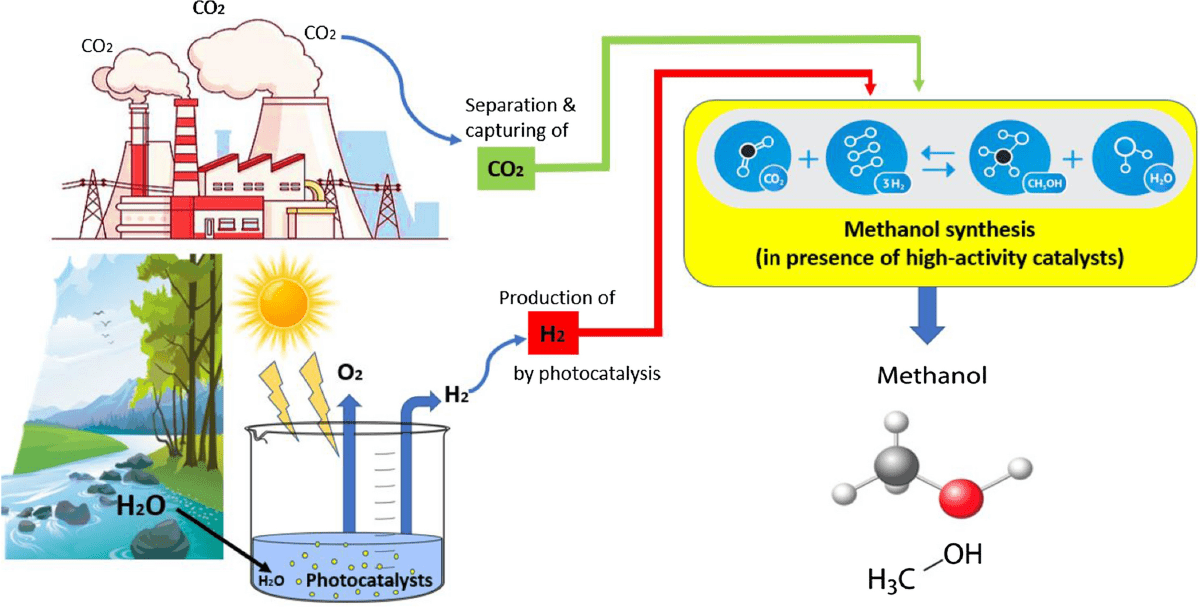
Conversion of Fossil Fuels to Methanol
- The conversion of fossil fuels to methanol holds substantial scope as both a method of utilizing fossil resources more cleanly and as a pathway toward sustainable energy solutions.
- Methanol (CH₃OH), a versatile chemical, can serve as a fuel, a fuel additive, and a key feedstock in the chemical industry.
- It is particularly promising as a means of reducing carbon emissions while producing a useful fuel and chemical product.
Scope and Benefits of Methanol Production from Fossil Fuels
- Alternative Fuel and Fuel Additive
- Direct Fuel: Methanol can be used directly as a fuel in internal combustion engines or blended with gasoline, or biogas fuel reducing reliance on petroleum.
- Fuel Cells: Methanol can also power direct methanol fuel cells (DMFCs), used in portable power applications and potentially in transport, providing a low-emission energy source.
- Marine Fuel: Methanol is a viable alternative fuel for the maritime industry due to its low sulfur content, enabling ships to meet stricter International Maritime Organization (IMO) regulations.
- Carbon-Neutral Potential
- CO₂ Utilization:
- The production of methanol from fossil fuels typically involves capturing and converting CO₂ emitted during fossil fuel use.
- Methanol production can thus be more sustainable if coupled with carbon capture and utilization (CCU) technologies.
- Circular Carbon Economy: By using CO₂ from fossil fuels or biomass, methanol production can close the carbon cycle, making it an essential contributor to a low-carbon or circular carbon economy.
- CO₂ Utilization:
- Feedstock for Chemicals and Plastics
- Methanol-to-Olefins (MTO): Methanol can be converted to ethylene and propylene, key building blocks for plastics and synthetic fibers, reducing the need for crude oil in chemical manufacturing.
- Acetic Acid and Formaldehyde Production: These derivatives are essential for adhesives, paints, and textiles. Using methanol from fossil fuel sources can reduce dependence on more direct fossil inputs for these chemicals.
- Energy Storage and Hydrogen Carrier
- Hydrogen Carrier: Methanol can serve as a liquid hydrogen carrier. Hydrogen derived from methanol can be extracted through catalytic reformation, facilitating hydrogen distribution and storage.
- Energy Storage: Methanol’s liquid state and stability make it an attractive energy storage medium, especially in power systems needing a medium for renewable energy storage.
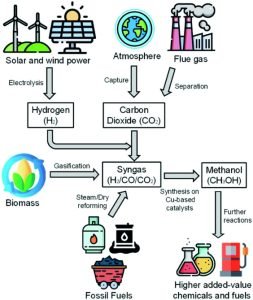
Key Processes for Methanol Production from Fossil Fuels
- Natural Gas to Methanol (GTM)
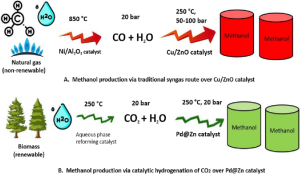
- Steam Methane Reforming (SMR): This widely-used process involves reacting natural gas with steam to produce synthesis gas (syngas), a mixture of CO and H₂, which is then converted to methanol.
- Autothermal Reforming (ATR): Combines partial oxidation with steam reforming, enhancing energy efficiency and producing a syngas with an ideal H₂ to CO ratio for methanol synthesis.
- Coal to Methanol (CTM)
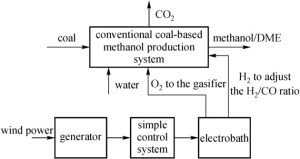
- Coal Gasification: Coal is gasified to produce syngas, which is subsequently converted into methanol through catalytic synthesis. This process is especially relevant in regions with abundant coal reserves, like China, where it is increasingly used to produce methanol at scale.
- Environmental Impact: While coal gasification is less clean than natural gas reforming, integrating carbon capture technologies can improve the environmental footprint of CTM processes.

Methanol prodcutions from coal and biomass
- Oil Residue and Heavy Hydrocarbons to Methanol
- Petroleum Residue Gasification: Heavy residuals from petroleum refining can be gasified, producing syngas for methanol synthesis. This method is particularly relevant for using byproducts from refineries that are challenging to process otherwise.

Advantages and Challenges of Methanol Production from Fossil Fuels
Advantages
- Efficiency and Existing Infrastructure: Fossil fuels provide a high-energy feedstock, and the existing infrastructure for coal and natural gas can be adapted for methanol production, making it economically viable.
- Emissions Reduction: By using carbon capture and integrating it into the methanol production process, CO₂ emissions from fossil fuels can be reused instead of being released.
- Flexibility: Methanol can be synthesized from various fossil sources, ensuring a diversified supply chain that is adaptable to different regions’ natural resources.
Challenges
- CO₂ Emissions: Although it can utilize CO₂, methanol production from fossil fuels without adequate capture can result in significant emissions.
- Economic Viability: Methanol production can be costly compared to more established fuels and chemicals, especially in regions without abundant natural gas or coal.
- Dependence on Fossil Fuels: Producing methanol from fossil fuels doesn’t fully align with long-term sustainability goals, as it perpetuates reliance on non-renewable resources.
Environmental Considerations and Future Outlook
- Integration with Renewable Hydrogen: Combining fossil-derived CO₂ with renewable hydrogen for methanol synthesis could reduce dependence on fossil fuels while producing methanol sustainably.
- Carbon Capture and Storage (CCS): Integrating CCS technologies with fossil-based methanol production can mitigate emissions, making the process closer to carbon-neutral.
- Blending with Bio-Methanol: Methanol from biomass or waste feedstocks can be blended with fossil-based methanol to reduce the carbon footprint and diversify methanol sources.
Applications and Market Potential
- Fuel Applications: Demand is growing in the transportation sector, especially for blended fuels and marine fuel.
- Chemical Manufacturing: Methanol’s versatility as a chemical feedstock ensures its continued demand in plastics, adhesives, solvents, and various chemicals.
- Power-to-Methanol Projects: Some companies are exploring using excess renewable electricity to generate hydrogen, which can then be used with fossil-derived CO₂ to synthesize methanol.
Conclusion
- The scope of methanol production from fossil fuels is substantial, especially as industries seek lower-emission fuel alternatives and the chemical industry increasingly values versatile feedstocks.
- With carbon capture and renewable integration, methanol synthesis from fossil sources can be a stepping stone to a cleaner and more diversified energy and chemicals market.
- Over time, a shift toward more sustainable methanol production pathways, integrating biomass and renewable hydrogen, can further reduce environmental impacts.
Reference
-
P. Gautam et al, Bio-methanol as a renewable fuel from waste biomass (2020)
-
Gaetono etal, Chapter 4 – Waste as a Source of Carbon for Methanol Production