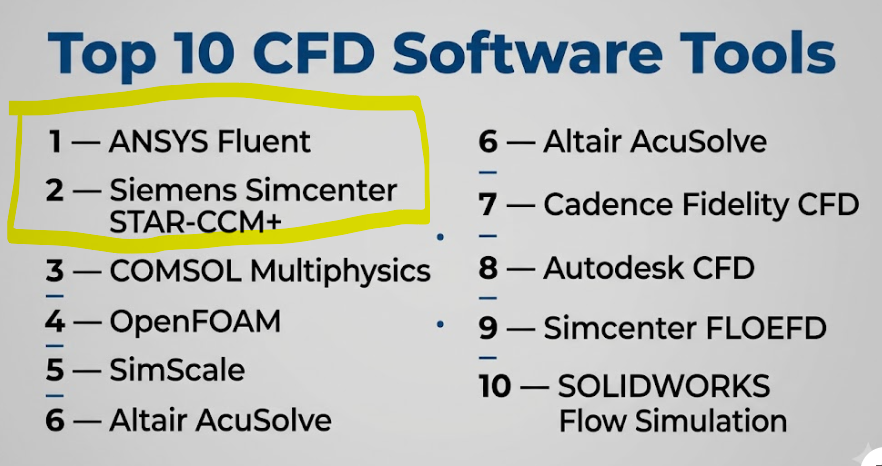
Top CFD Tools Used in Industry
- Both ANSYS Fluent and STAR-CCM+ are leading industrial CFD tools. The “best” choice depends on the application, industry, and workflow requirements.
| Rank | CFD Software | Developer | Major Industries | Strengths | Typical Applications |
|---|---|---|---|---|---|
| 1 | ANSYS Fluent | ANSYS | Energy, Boiler, Furnace, Chemical, HVAC | Combustion, Heat Transfer, Multiphase Flow | Boilers, Burners, Furnaces, Heat Exchangers |
| 2 | Simcenter STAR-CCM+ | Siemens | Automotive, Aerospace, Marine, EV | Automation, Integrated Workflow | Vehicle Aerodynamics, Battery Cooling |
| 3 | OpenFOAM | OpenCFD Ltd. | Research, Energy, Consulting | Open Source, Highly Customizable | Academic and Industrial Research |
| 4 | COMSOL Multiphysics | COMSOL | Multiphysics, Electronics, R&D | CFD + Structural + Electromagnetic Coupling | Fuel Cells, Batteries, MEMS |
| 5 | Simcenter FLOEFD | Siemens | Electronics, Product Design | CAD-Embedded CFD | Electronics Cooling |
| 6 | Autodesk CFD | Autodesk | Building Services, HVAC | Easy Learning Curve | HVAC and Ventilation |
| 7 | Cadence Fidelity CFD | Cadence | Aerospace, Automotive | High-Speed Aerodynamics | Aircraft and Vehicle Design |
| 8 | Altair AcuSolve | Altair | Manufacturing, Automotive | Robust Meshing | Casting and Thermal Management |
| 9 | CONVERGE CFD | Convergent Science | IC Engines, Combustion | Automatic Meshing | Engine CombFLOW-3D |
When ANSYS Fluent is the Best
ANSYS Fluent — pros
- User friendly CFD tool and integrated GUI makes easier solution set up
- Industry-standard general-purpose solver.
- More diversified Physical models for turbulence, combustion, and battery models
- Best for fast convergence of solutions
- Best for Hybrid mesh
- Suitable for customized patching of initial solutions
- Large user base and detailed User guides
- Strong for combustion, heat transfer, multiphase flow, CHT, and battery/energy applications; recent Fluent updates highlight combustion improvements, battery venting, immersion cooling, PEM fuel-cell cold-start, and faster optimization inside the Fluent interface.
- Very strong customization through UDFs, which is useful when industry cases need special boundary conditions, source terms, or physics tweaks.
- Good meshing and diagnostics support inside the Fluent environment, which helps with engineering validation and cleanup of industrial geometries.
- Fluent’s GPU solver and recent performance work can be valuable when solve time is a major constraint
| Advantage | Description |
|---|---|
| Strong Physics Models | Extensive models for combustion, multiphase flow, heat transfer, radiation, and chemical reactions. |
| Industry Acceptance | Widely used in power plants, boilers, furnaces, chemical processing, and HVAC industries. |
| Excellent Combustion Modeling | Strong support for biomass, coal, gas, and oil-fired systems. |
| UDF Capability | User-Defined Functions (UDFs) allow highly customized models and control logic. |
| Large User Community | More training material, tutorials, research papers, and experienced users. |
| Academic Support | Most universities teach Fluent, making recruitment easier. |
| Integration | Works well with other ANSYS tools for structural, thermal, and optimization studies. |
ANSYS Fluent — cons
- For some teams, the flexibility comes with more setup effort and more expert tuning; that is an inference from the large number of modeling, meshing, and UDF options Fluent exposes.
- If your organization wants a very tightly integrated “one workflow” environment, Fluent can feel more modular than STAR-CCM+; that is also an inference from the product positioning
| Limitation | Description |
|---|---|
| Meshing Workflow | Can involve multiple software modules and preprocessing steps. |
| Automation | Less streamlined than STAR-CCM+ for large design studies. |
| Learning Advanced Features | Advanced combustion and UDF development require significant expertise. |
| Workflow Complexity | Managing geometry, meshing, solving, and post-processing may involve several interfaces. |
When Siemens STAR-CCM+ is the Best:
STAR-CCM+ — pros
- Siemens positions STAR-CCM+ as a single unified CFD tool with fully integrated workflow automation, robust automated meshing, embedded design exploration, and multiphysics modeling.
- It is built to tackle complex multiphysics simulations and to improve throughput with automated workflows and scalable solvers on GPU, CPU, and ARM.
- That makes it especially attractive for teams that value automation, repeatability, and CAD-to-results efficiency
- All CFD tools (pre-processing -geometry and meshing, simulation, post) in One umbrella (single files)
- Excellent for complex geometries.
- Automation and custom functions
- Meshing only: polyhedral, tetra, or prism layers, pure hexa (cut cell)
- Best for customization options like meshing, CFD post using scripts when GUI take more times
- Controlled vector and streamlines with rendering effect
| Advantage | Description |
|---|---|
| Single Integrated Environment | Geometry, meshing, solving, and post-processing are in one platform. |
| Automated Meshing | Excellent automated mesh generation for complex industrial geometries. |
| Design Exploration | Strong built-in automation and optimization capabilities. |
| CAD Robustness | Handles frequent CAD changes efficiently. |
| Parametric Studies | Particularly effective for large batches of simulations. |
| Rotating Machinery | Strong capabilities for pumps, fans, compressors, and turbines. |
| Automotive Applications | Widely used by automotive and EV manufacturers. |
STAR-CCM+ — cons
- Because it is designed around a broad integrated platform, it can be more than you need for simpler, narrowly scoped CFD work; that is an inference from its feature set and scope.
- Teams that rely heavily on deep custom code-based workflow tailoring may prefer Fluent’s UDF-centric approach; this is an inference based on Fluent’s documented UDF capability
| Limitation | Description |
|---|---|
| Smaller User Base | Fewer training resources and tutorials compared with Fluent. |
| Combustion Flexibility | Excellent, but many combustion specialists still prefer Fluent’s flexibility. |
| Customization | Less flexible than Fluent’s UDF framework for highly specialized models. |
| Academic Exposure | Less common in universities, making experienced hires harder to find. |
| Licensing Cost | Can be expensive depending on the required modules and HPC usage. |
ANSYS Fluent vs STAR-CCM+ Comparison
| Parameter | ANSYS Fluent | STAR-CCM+ |
|---|---|---|
| Developer | ANSYS | Siemens STAR-CCM+ |
| Learning Curve | Easier for beginners | Slightly steeper |
| User Interface | Traditional workflow | Integrated modern workflow |
| Meshing | Powerful, flexible | Highly automated |
| Complex Geometry Handling | Excellent | Excellent |
| Combustion Modeling | Industry-leading | Very good |
| Boiler & Furnace CFD | Excellent | Good to Excellent |
| Multiphase Flows | Excellent | Excellent |
| Rotating Machinery | Good | Excellent |
| Automotive Aerodynamics | Good | Excellent |
| Heat Transfer | Excellent | Excellent |
| Optimization | ANSYS OptiSLang integration | Built-in automation tools |
| HPC Scalability | Excellent | Excellent |
| Custom UDF Programming | Strong capability | Less flexible than Fluent |
| Academic Usage | Very common | Less common |
| Industrial Usage | Very high | Very high |
Best Tool by Industry
| Industry/Application | Preferred Tool |
|---|---|
| Industrial Boilers | ANSYS Fluent |
| Furnaces & Burners | ANSYS Fluent |
| Combustion Systems | ANSYS Fluent |
| Thermal Power Plants | ANSYS Fluent |
| HVAC Systems | ANSYS Fluent |
| Chemical Reactors | ANSYS Fluent |
| Automotive Aerodynamics | STAR-CCM+ |
| Electric Vehicles | STAR-CCM+ |
| Battery Thermal Management | STAR-CCM+ |
| Marine Applications | STAR-CCM+ |
| Turbomachinery | STAR-CCM+ |
| Aerospace Aerodynamics | STAR-CCM+ |
For Boiler, Furnace, and Thermal Engineers
Since many of your interests involve:
- Industrial boilers
- Burners
- Furnaces
- Combustion systems
- Heat transfer
- CFD consulting
ANSYS Fluent is generally the preferred choice.
Reasons:
- Advanced combustion models.
- Extensive radiation models (DO, P1, WSGGM).
- Strong coal, biomass, and gaseous fuel combustion capabilities.
- Widely accepted by boiler OEMs and thermal power industries.
- Large user community and support resources.
Typical Applications in Fluent
ANSYS Tool for Combustion

- D-type boilers
- FBC boilers
- Biomass furnaces
- Jaggery furnaces
- Industrial burners
- Chimney draft analysis
- Heat exchanger design
For EV and Advanced Product Development
STAR-CCM+ is often preferred for:Typical Applications in STAR-CCM+


- EV battery cooling
- Vehicle aerodynamics
- Under-hood thermal management
- Rotating machinery
- Marine hydrodynamics
Industry Demand (2026)
| Sector | More Common Tool |
|---|---|
| Thermal Engineering | ANSYS Fluent |
| Boiler OEMs | ANSYS Fluent |
| Furnace OEMs | ANSYS Fluent |
| Energy Auditing & Heat Transfer | ANSYS Fluent |
| Automotive OEMs | STAR-CCM+ |
| EV Companies | STAR-CCM+ |
| Aerospace | Both |
| Consulting Companies | Both |
| Industry | Preferred Tool |
|---|---|
| Industrial Boilers | Fluent |
| Power Plants | Fluent |
| Furnaces & Burners | Fluent |
| Biomass Combustion | Fluent |
| HVAC | Fluent |
| Chemical Reactors | Fluent |
| Automotive Aerodynamics | STAR-CCM+ |
| Electric Vehicles | STAR-CCM+ |
| Marine Engineering | STAR-CCM+ |
| Pumps & Compressors | STAR-CCM+ |
| Turbomachinery | STAR-CCM+ |
| Consumer Products | STAR-CCM+ |
Recommendation
- For a professional working in boilers, furnaces, combustion, biomass energy, heat transfer, and thermal systems, ANSYS Fluent is usually the better investment of time and training.
- If your focus is EVs, automotive aerodynamics, battery cooling, or marine applications, then STAR-CCM+ has advantages due to its automation and integrated workflow.
- For most thermal engineering consultants, learning ANSYS Fluent first and then adding STAR-CCM+ later provides the broadest industrial opportunities.