
Industrial Boiler: Basics
- Industrial boilers sit at the heart of power plants, refineries, chemical units, food processing, and countless manufacturing lines.
- They convert fuel energy into steam or hot water—a versatile utility for heating, power generation, and process use.
- This guide gives you a practical, engineering-focused overview from fundamentals to design.
- An industrial boiler is a closed pressure vessel where water is heated to produce steam or hot water using fuels such as coal, oil, gas, or biomass.
Core elements
- Furnace – where fuel burns
- Heat transfer surfaces – tubes/walls that absorb heat
- Drums (water/steam) – separation and storage
- Flue gas path – carries hot gases across heat exchangers
- Auxiliaries – fans, pumps, burners, controls, safety devices
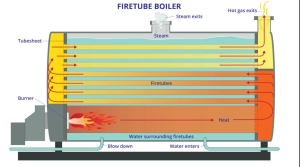
Main Boiler Components
Combustion Side
- Burner
- Furnace
- Refractory
- Air preheater
- FD/ID fans
- Chimney
Steam-Water Side
- Steam drum
- Mud drum
- Water wall tubes
- Superheater
- Economizer
- Downcomers and risers
Types of Industrial Boilers
Boilers are commonly classified by:
- Flow path: Fire-tube vs Water-tube
- Fuel: Coal, oil, gas, biomass, waste heat
- Pressure: Low, medium, high
- Circulation: Natural or forced
- Application: Process steam, power generation, heating
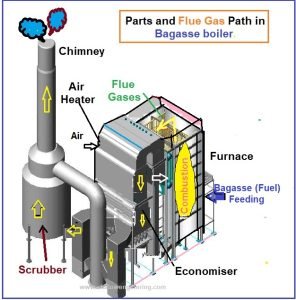
Types and application of boiler Types
his is useful for selection, design, and even CFD case definition.
| Requirement | Recommended Boiler Type |
|---|---|
| Low pressure (<25 bar), small load | Fire tube |
| Medium pressure (20–50 bar) | Packaged boiler |
| High pressure (>50 bar), large load | Water tube (D-type) |
| Very high efficiency power plant | Supercritical / Benson |
| Low-grade fuel / biomass | FBC / CFBC |
| Waste heat utilization | WHRB |
| Zero emissions (local) | Electric boiler |
Summary of boiler applications
- Water tube boilers dominate high-pressure and high-capacity applications.
- Fire tube boilers are preferred for small steam loads and low pressure.
- CFBC boilers are widely used for low-grade coal and biomass flexibility.
- Once-through and Benson boilers are important for supercritical power plants.
- WHRB systems are increasingly used for energy recovery and decarbonization.
| Boiler Type | Pressure Range (bar) | Steam Temperature (°C) | Typical Capacity | Fuel Type | Key Applications |
|---|---|---|---|---|---|
| Fire Tube Boiler | 5 – 25 | 150 – 250 (saturated) | Up to ~20 TPH | Gas, Oil | Small industries, laundries, food processing, hotels |
| Packaged Boiler (Fire/Water Tube) | 10 – 40 | 180 – 350 | 5 – 50 TPH | Gas, Oil | Medium industries, pharmaceuticals, chemical plants |
| Water Tube Boiler (D-Type, A-Type, O-Type) | 20 – 150 | 250 – 540 | 10 – 500 TPH | Coal, Gas, Oil, Biomass | Power plants, refineries, large process industries |
| High-Pressure Boiler (Subcritical) | 80 – 180 | 480 – 540 | 100 – 1000+ TPH | Coal, Gas | Thermal power plants |
| Supercritical Boiler | > 220 | 540 – 600+ | 500 – 2000+ TPH | Coal, Gas | Ultra-mega power plants (high efficiency) |
| Fluidized Bed Boiler (FBC/CFBC) | 20 – 170 | 450 – 550 | 20 – 500 TPH | Coal, Biomass, Waste | Power plants, biomass plants, cement, steel |
| Waste Heat Recovery Boiler (WHRB) | 5 – 120 | 200 – 500 | 5 – 200 TPH | Waste gas | Cement, steel, gas turbines, refineries |
| Electric Boiler | 5 – 25 | 150 – 300 | Small to medium | Electricity | Clean environments, hospitals, labs |
| Once-Through (Benson Boiler) | 150 – 300+ | 500 – 620 | 500 – 2000+ TPH | Coal, Gas | Supercritical/ultra-supercritical plants |
Application-Based Selection
| Application | Recommended Boiler Type | Reason |
|---|---|---|
| Small industry (food, laundry) | Fire-tube / Packaged | Low cost, simple operation |
| Medium process industry | Packaged / Water-tube | Moderate pressure & flexibility |
| Large refinery / chemical plant | Water-tube (D-type) | High reliability & pressure |
| Thermal power plant | High pressure / Supercritical | Maximum efficiency |
| Biomass-based plant | FBC / Biomass boiler | Fuel flexibility |
| Cement / steel plant | WHRB | Waste heat utilization |
| Clean environment (hospital) | Electric boiler | Zero emissions |
Recirculation Ratio for Different Boiler
| Boiler Type | Typical Application | Circulation Type / Ratio | Typical Efficiency (%) | Common Fuel Type | Typical Steam Pressure |
|---|---|---|---|---|---|
| Fire Tube Boiler | Hotels, laundries, food processing, small industries | Natural circulation, low CR | 70–85 | LPG, PNG, diesel, FO, biomass | 5–25 bar |
| Cochran Boiler | Small process plants | Natural circulation | 70–80 | Coal, oil, gas | 5–15 bar |
| Lancashire Boiler | Old textile and process industries | Natural circulation | 65–75 | Coal | 5–20 bar |
| Babcock & Wilcox Boiler | Medium-pressure industries | Natural circulation, CR: 5–10 | 75–88 | Coal, oil, gas | 20–80 bar |
| D-Type Water Tube Boiler | Refineries, petrochemical plants | Natural circulation, CR: 8–20 | 85–92 | Gas, oil, multi-fuel | 30–150 bar |
| O-Type Boiler | Packaged steam plants | Natural circulation, CR: 8–15 | 85–91 | Gas, oil | 20–120 bar |
| A-Type Boiler | Marine and process industries | Natural circulation, CR: 6–15 | 82–90 | Oil, gas, biomass | 20–100 bar |
| Bent Tube Boiler | High-pressure industrial steam systems | Natural circulation, CR: 10–25 | 85–90 | Coal, oil, gas | 40–180 bar |
| Stirling Boiler | Thermal plants and heavy industries | Natural circulation, CR: 10–30 | 80–90 | Coal, biomass | 30–170 bar |
| LaMont Boiler | High-pressure industrial plants | Forced circulation, CR: 8–10 | 85–92 | Coal, oil, gas | 100–180 bar |
| Loeffler Boiler | Utility power generation | Forced circulation using steam | 88–93 | Coal, oil | 100–140 bar |
| Benson Boiler | Supercritical thermal power plants | Once-through, CR ≈ 1 | 90–96 | Coal, gas | 220–300+ bar |
| Once-Through Boiler | Supercritical and ultra-supercritical plants | No steam drum, CR ≈ 1 | 90–95 | Coal, gas | 180–300+ bar |
| Velox Boiler | Rapid steam generation systems | Forced circulation | 85–90 | Gas, oil | 40–100 bar |
| Fluidized Bed Combustion (FBC) Boiler | Captive power and process plants | Natural/forced, CR: 10–25 | 80–90 | Coal, biomass, petcoke | 20–140 bar |
| AFBC Boiler | Small-medium process plants | Natural circulation | 78–88 | Coal, biomass | 20–100 bar |
| CFBC Boiler | Large utility and captive power plants | Natural circulation, CR: 15–30 | 85–92 | Coal, petcoke, biomass | 60–180 bar |
| Pulverized Coal Boiler | Large thermal power stations | Natural/forced circulation | 88–94 | Pulverized coal | 130–250 bar |
| Waste Heat Recovery Boiler (WHRB/HRSG) | Cement, steel, gas turbines | Natural or forced circulation | 70–90 | Exhaust gas/waste heat | 10–120 bar |
| HRSG (Heat Recovery Steam Generator) | Combined cycle power plants | Natural/forced circulation | 80–92 | Gas turbine exhaust | 30–180 bar |
| Biomass Water Tube Boiler | Sugar, agro-processing industries | Natural circulation, CR: 10–20 | 75–88 | Bagasse, wood chips, rice husk | 20–120 bar |
| Recovery Boiler | Pulp and paper industries | Natural circulation | 65–80 | Black liquor | 40–100 bar |
| Marine Water Tube Boiler | Ships and offshore plants | Natural circulation | 80–90 | Marine oil, LNG | 20–100 bar |
| Electric Boiler | Pharmaceutical and clean steam applications | No combustion circulation | 95–99 | Electricity | 5–85 bar |
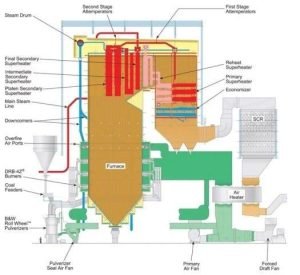
Hybrid Boiler
Design of Industrial Boiler
- Industrial boiler design is the process of developing a safe, efficient, reliable, and economical system for generating steam or hot water for industrial applications such as power plants, refineries, chemical plants, food industries, paper mills, textile plants, and process industries.
Main Objective of Boiler Design
- The primary goals are:
- Generate required steam quantity
- Maintain required pressure and temperature
- Achieve high thermal efficiency
- Ensure safe operation
- Minimize emissions
- Provide long operational life
Key Boiler Process Design Criteria
| Design Criteria | Description | Typical Design Considerations |
|---|---|---|
| Steam Capacity | Required steam generation rate | kg/hr or TPH based on plant load |
| Steam Pressure | Operating steam pressure | Low, medium, high, supercritical |
| Steam Temperature | Saturated or superheated steam | Process requirement |
| Load Variation | Turndown and fluctuating demand | 25–100% load operation |
| Fuel Type | Fuel availability and quality | Gas, oil, coal, biomass, petcoke |
| Fuel Heating Value | Energy content of fuel | GCV/NCV affects furnace sizing |
| Boiler Efficiency | Thermal performance target | Typically 80–95% |
| Furnace Heat Release Rate | Heat input per furnace volume | Controls flame stability |
| Combustion Air Requirement | Air needed for complete combustion | Stoichiometric + excess air |
| Excess Air Level | Additional air for safe combustion | Gas: 10–15%, Coal: 20–40% |
| Flue Gas Temperature | Stack exit temperature | Affects efficiency |
| Heat Transfer Surface Area | Tube area required | Evaporator, SH, ECO sizing |
| Water Circulation Ratio | Steam-water circulation stability | Natural or forced circulation |
| Tube Metal Temperature | Avoid tube overheating | Material limitation |
| Pressure Drop | Gas-side and water-side losses | Fan and pump selection |
| Draft System | Furnace pressure control | FD fan, ID fan, balanced draft |
| Emission Limits | Environmental compliance | NOx, SOx, PM, CO |
| Ash Characteristics | Slagging and fouling tendency | Coal and biomass systems |
| Blowdown Requirement | Water quality control | TDS limitation |
| Feedwater Quality | Corrosion and scaling control | DM water treatment |
| Start-up Time | Boiler response speed | Package vs utility boiler |
| Safety Margin | Design code allowance | ASME, IBR compliance |
| Material Selection | High-temperature strength | Carbon steel, alloy steel |
| Thermal Expansion | Tube and drum expansion | Expansion joints/supports |
| Burner Design | Flame shape and stability | Multi-fuel compatibility |
| Superheater Temperature Control | Steam temperature regulation | Spray attemperator |
| Economizer Design | Feedwater heat recovery | Improve efficiency |
| Air Preheater Design | Combustion air heating | Increase combustion efficiency |
| Chimney/Stack Design | Proper flue gas discharge | Draft and pollution norms |
| Automation Level | Control philosophy | PLC/DCS systems |
| Reliability & Availability | Continuous operation capability | Redundancy and maintenance |
| Maintenance Accessibility | Ease of inspection and repair | Tube access/manholes |
| Space Constraints | Layout limitations | Package vs field erected |
| Capital Cost | Initial project investment | Equipment and installation |
| Operating Cost | Fuel and maintenance cost | Lifecycle optimization |
Most Critical Boiler Design Priorities
- Safe pressure containment
- Stable combustion
- Proper water circulation
- High thermal efficiency
- Low emissions
- Reliable steam quality
- Tube life protection
- Easy maintenance
- Fuel flexibility
- Compliance with ASME/IBR standard
Scope of CFD Modeling
- This guide compares how you would model, simulate, and interpret results for three major boiler types using CFD tools like Ansys Fluent, OpenFOAm.
- It’s structured like a mini project plan you can directly apply to real industrial cases or publish as a technical blog.
- Boiler heat transfer is governed by complex coupling of:
-
- Combustion (heat generation)
- Radiation (dominant in furnace)
- Convection (gas-side heat transfer)
- Fluid flow (air–fuel mixing)
- CFD solves all of these simultaneously to give spatial (3D) insight that experiments alone cannot provide.
-
Furnace Heat Transfer Optimization
- Predict flame shape and temperature distribution
- Optimize burner location, tilt, and swirl
-
Water Wall Heat Flux Prediction
-
- Avoid flame impingement on tubes
- Estimate local heat flux (kW/m²) on tubes
- Identify hot spots → tube failure risk
- Optimize tube spacing and arrangement
-
Critical for tube life and reliability
| Feature | Fire Tube | Water Tube | FBC / CFBC |
|---|---|---|---|
| Solver | Pressure-based | Pressure-based | Pressure-based (transient often) |
| Turbulence | k-ε / RNG k-ε | k-ε / k-ω SST | k-ε + multiphase coupling |
| Combustion | EDM / Non-premixed | EDM / PDF | Volumetric + surface (char) |
| Radiation | P1 / DO | DO preferred | P1 / DO |
| Multiphase | — | — | Eulerian / Dense Discrete Phase |
| Species | Yes | Yes | Yes (with reactions) |
| Output | Fire Tube | Water Tube | FBC |
|---|---|---|---|
| Flame shape | Moderate | Critical | Distributed |
| Temperature | Uniform tubes | Furnace gradients | Bed uniformity |
| Heat flux | Tube inner walls | Water walls (critical) | Bed + walls |
| CO/NOx | Low-medium | High importance | Low NOx |
| Velocity | Tube velocity | Furnace circulation | Particle mixing |
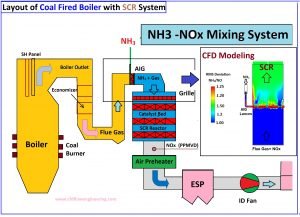
Boiler Pressure Classification
| Boiler Category | Steam Pressure Range |
|---|---|
| Low Pressure Boiler | Up to 20 bar |
| Medium Pressure Boiler | 20–80 bar |
| High Pressure Boiler | 80–180 bar |
| Supercritical Boiler | Above 221 bar |
| Ultra-Supercritical Boiler | Above 250 bar |
Typical Boiler Selection by Steam Pressure
| Steam Pressure | Preferred Boiler Type |
|---|---|
| 5–20 bar | Fire tube boiler |
| 20–60 bar | Packaged water tube boiler |
| 60–120 bar | D-type, O-type, CFBC |
| 120–180 bar | High-pressure water tube boiler |
| >220 bar | Benson / Once-through boiler |
Conclusion
The scope of CFD in boiler heat transfer modeling is very high and growing rapidly. It enables:
- Deep understanding of heat transfer
- Safer and more efficient boiler design
- Reduced emissions and fuel consumption