Disadvantages: Higher initial cost, requires specific installation conditions.
Pulverized Coal-Fired Boilers
Working Principle: Coal is pulverized to a fine powder and burned to heat water in the boiler.
Common Uses: Large power plants, steel plants, and refineries.
Advantages: High steam generation, suitable for large-scale industries.
Disadvantages: High emissions, requires complex emissions control systems.
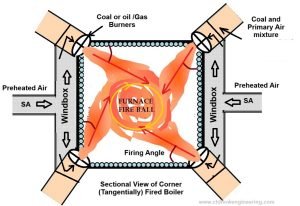
Combustion System for Corner fired boiler
Firing Capacities of Industrial Boiler
The firing capacity of an industrial boiler refers to the maximum amount of fuel that can be burned in a boiler to produce the required amount of heat or steam.
It is usually measured in terms of energy output (e.g., BTU/hr, MW, or horsepower) or fuel consumption (e.g., kg of fuel/hr).
Firing capacity depends on the type of boiler, its size, fuel type, and operational design.
Here are typical firing capacities for various types of industrial boilers:
Fire-Tube Boilers
Firing Capacity: Typically ranges from 0.5 to 20 tons of steam per hour (TPH).
Heat Output: Approximately 500,000 to 15 million BTU/hr (150 kW to 4.4 MW).
Fuel: Can use natural gas, oil, coal, or biomass.
Water-Tube Boilers
Firing Capacity: Can range from 5 to 500 TPH.
Heat Output: Approximately 4 to 500 million BTU/hr (1.2 MW to 146 MW).
Fuel: Typically uses natural gas, oil, coal, or biomass.
High-Capacity Use: Power generation plants may have capacities exceeding 1000 TPH.
Package Boilers
Firing Capacity: Typically between 1 to 25 TPH.
Heat Output: Around 1 million to 30 million BTU/hr (0.3 MW to 8.8 MW).
Fuel: Often designed to run on natural gas or light oil, though multi-fuel systems are also available.
Electric Boilers
Firing Capacity: Generally lower, ranging from 1 to 10 TPH.
Heat Output: Around 500,000 to 10 million BTU/hr (150 kW to 3 MW).
Fuel: Electricity, with no direct fuel consumption.
Fluidized Bed Boilers
Firing Capacity: Can range from 10 to 300 TPH, depending on the system design.
Heat Output: Between 10 million to 300 million BTU/hr (3 MW to 88 MW).
Fuel: Can burn various solid fuels, including coal, biomass, or waste materials.
Waste Heat Boilers
Firing Capacity: Ranges from 5 to 100 TPH.
Heat Output: Varies, depending on the amount of available waste heat, typically 3 million to 150 million BTU/hr (0.9 MW to 44 MW).
Fuel: Utilizes heat from process exhaust gases.
Biomass Boilers
Firing Capacity: Usually between 1 to 100 TPH.
Heat Output: Typically 1 million to 150 million BTU/hr (0.3 MW to 44 MW).
Fuel: Biomass fuels like wood chips, agricultural residues, or pellets.
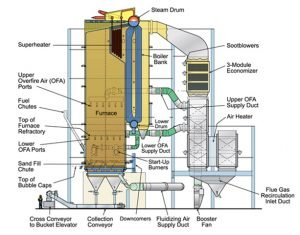
Pulverized Coal-Fired Boilers
Firing Capacity: Large industrial units may exceed 500 TPH.
Heat Output: Ranges from 50 million to 1500 million BTU/hr (14.6 MW to 440 MW).
Fuel: Coal (pulverized into a fine powder for efficient combustion).
Condensing Boilers
Firing Capacity: Typically ranges from 0.5 to 20 TPH.
Heat Output: Approximately 500,000 to 20 million BTU/hr (150 kW to 5.9 MW).
Fuel: Natural gas or oil, with a focus on maximizing heat extraction.
Steam Drum Boilers
Firing Capacity: Can range from 20 to 300 TPH.
Heat Output: Around 20 million to 300 million BTU/hr (5.9 MW to 88 MW).
Fuel: Coal, natural gas, or oil.
Summary of Firing Capacities:
Small Industrial Boilers: 0.5 to 10 TPH (500,000 to 30 million BTU/hr).
Medium Industrial Boilers: 10 to 50 TPH (10 to 150 million BTU/hr).
Large Industrial Boilers: 50 to 500+ TPH (50 million to 500+ million BTU/hr).
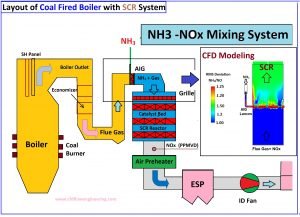
CFD modeling boiler with_SCR
Scope CFD Modeling for Industrial Boiler
The scope of Computational Fluid Dynamics (CFD) modeling for industrial boilers is vast, covering several key aspects of boiler design, optimization, operation, and emissions control.
CFD simulations are highly valuable for improving the efficiency, reliability, and environmental performance of industrial boilers. Here’s a breakdown of the scope:
Combustion Optimization
Objective: Improve fuel combustion efficiency to maximize energy output and reduce fuel consumption.
CFD Application: Simulate the combustion process inside the boiler, analyzing the distribution of temperature, air-fuel mixture, and flame stability.
Benefits:
Optimizes burner designs and placement.
Reduces unburnt carbon and ensures complete combustion.
Minimizes excess air usage to reduce heat loss.
Heat Transfer Enhancement
Objective: Enhance the heat exchange between combustion gases and water/steam in the boiler to maximize energy efficiency.
CFD Application: Model the flow of hot gases through the heat exchanger tubes or boiler walls to understand heat transfer mechanisms.
Benefits:
Identifies areas with low heat transfer efficiency.
Helps in redesigning boiler tubes, baffles, or finned surfaces for improved performance.
Optimizes flue gas recirculation for better heat recovery.
Flow Distribution and Mixing
Objective: Ensure proper distribution of air, fuel, and exhaust gases in the boiler.
CFD Application: Simulate airflow paths and fuel injection points to understand fluid dynamics inside the furnace.
Benefits:
Prevents poor mixing of fuel and air, which leads to inefficiency and pollutant formation.
Reduces localized hot spots and ensures uniform temperature distribution.
Avoids regions of stagnant or recirculating flow that can lead to slagging and fouling.
Emissions Reduction
Objective: Minimize the release of harmful pollutants like NOx, CO, and particulate matter.
CFD Application: Model chemical reactions, combustion temperatures, and gas-phase interactions to understand pollutant formation.
Benefits:
Helps to design low-NOx burners and optimize combustion conditions.
Analyzes flue gas recirculation strategies to reduce NOx formation.
Evaluates post-combustion treatments like selective catalytic reduction (SCR) for minimizing emissions.
Boiler Fouling and Slagging
Objective: Reduce fouling and slagging, which degrade boiler efficiency and lead to maintenance shutdowns.
CFD Application: Simulate particulate deposition and ash behavior inside the boiler.
Benefits:
Identifies areas prone to ash buildup or slagging.
Helps in designing soot blowers and ash removal systems.
Optimizes operational parameters to minimize fouling.
Thermal Stress and Structural Analysis
Objective: Assess the thermal stresses in boiler components to avoid material failure.
CFD Application: Couple CFD with Finite Element Analysis (FEA) to evaluate the structural integrity of critical components, such as boiler tubes and drums, under thermal loads.
Benefits:
Predicts thermal fatigue and failure points.
Helps in selecting suitable materials and thickness for boiler walls.
Improves the reliability and lifespan of boiler components.
7. Boiler Efficiency Improvement
Objective: Maximize the overall efficiency of the boiler by reducing heat losses and optimizing operations.
CFD Application: Simulate the entire boiler operation, including combustion, heat transfer, and fluid dynamics.
Benefits:
Reduces boiler downtime and maintenance by optimizing heat transfer surfaces.
Increases efficiency by tuning operational parameters like fuel-air ratios.
Reduces fuel consumption by identifying areas of improvement.
Retrofit and Upgradation Analysis
Objective: Evaluate potential design modifications or upgrades to improve the performance of existing boilers.
CFD Application: Simulate the effects of retrofits such as new burner designs, heat recovery systems, or emissions control technologies.
Benefits:
Allows for testing design changes virtually before implementation.
Identifies the most cost-effective upgrades for efficiency or emission reductions.
Reduces downtime by providing a clear plan for boiler modifications.
Multi-Phase Flow Simulation
Objective: Model the behavior of two or more interacting phases, such as steam and water, or combustion particles in the gas stream.
CFD Application: Simulate the interaction between solid particles (e.g., ash) and gas or liquid phases inside the boiler.
Benefits:
Predicts steam formation and condensation behavior.
Improves understanding of fluidized bed dynamics in Fluidized Bed Boilers (CFB, BFB).
Optimizes soot-blowing operations for solid fuel boilers.
Flue Gas and Exhaust Optimization
Objective: Design effective exhaust systems for efficient removal of combustion products.
CFD Application: Model the flow of flue gases through ducts, chimneys, and exhaust fans.
Benefits:
Ensures optimal flue gas velocity and minimizes pressure losses.
Designs systems to reduce particulate carryover and optimize stack height.
Enhances the recovery of waste heat from exhaust gases.
Transient and Dynamic Analysis
Objective: Analyze the transient behavior of boilers during startup, shutdown, or load changes.
CFD Application: Model the dynamic behavior of temperature, pressure, and flow fields over time.
Benefits:
Helps in safe and efficient boiler operation during changing load conditions.
Identifies potential safety hazards like thermal shock or pressure surges.
Optimizes control systems for dynamic responses.
Energy Recovery and Waste Heat Utilization
Objective: Improve energy recovery from waste heat in processes like heat recovery steam generators (HRSG).
CFD Application: Simulate the waste heat recovery process and heat exchanger performance.
Benefits:
Optimizes heat exchanger designs to maximize heat recovery.
Reduces energy costs by utilizing waste heat more effectively.
Lowers carbon footprint by enhancing overall energy efficiency.
Conclusion
Each type of industrial boiler is suited for specific applications depending on the scale of the operation, fuel availability, and efficiency requirements.
The exact firing capacity of an industrial boiler depends on several factors, including the fuel type, boiler design, and operational requirements.
Large-scale applications like power plants or refineries require high-capacity boilers, while smaller industries may use compact boilers with lower firing capacities.
CFD modeling for industrial boilers offers significant potential for improving operational efficiency, reducing emissions, and ensuring the longevity of boiler systems.
Its applications cover combustion, heat transfer, flow distribution, emissions control, and structural integrity, making it a powerful tool in both the design and optimization of boilers in industries like power generation, chemical processing, and oil & gas.