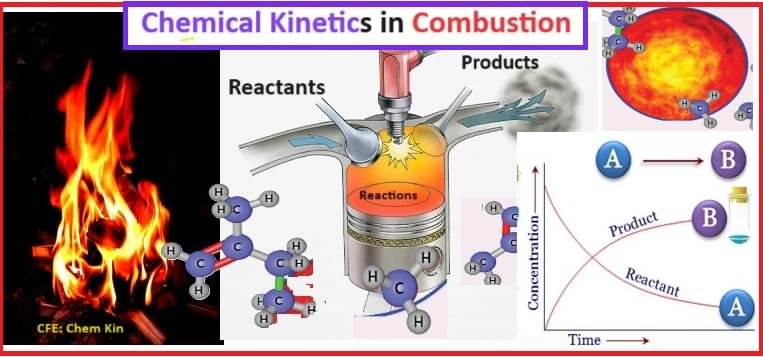
What is Detailed Chemical Kinetics
- Detailed chemical kinetics in combustion modeling refers to the comprehensive study and representation of the chemical reactions and pathways involved in the combustion process.
- This involves modeling the individual steps of fuel breakdown, intermediate species formation, and oxidation reactions that occur during combustion.
- These models account for the chemical transformation of fuel molecules, which may involve hundreds of species and thousands of elementary reactions.
Applications of Detailed Chemical Kinetics
- Gas Turbines: Used to predict flame behavior and optimize turbine efficiency and emission control.
- Internal Combustion Engines: Helps in modeling combustion, auto-ignition, and pollutant formation in engines.
- Industrial Burners: Supports cleaner and more efficient combustion in industrial heating systems.
- Alternative Fuels: Essential for understanding the combustion characteristics of biofuels, synthetic fuels, and hydrogen.
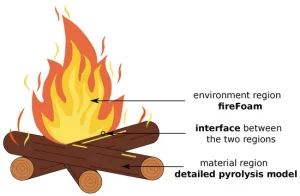

Key Aspects of Detailed Chemical Kinetics in Combustion Modeling
Elementary Reactions:
- These are the fundamental chemical reactions that occur during combustion. Each reaction involves the breaking and forming of chemical bonds, which leads to the formation of new molecules.
- Example: In hydrocarbon combustion, methane (CH₄) oxidizes through several elementary reactions involving oxygen, producing water (H₂O), carbon dioxide (CO₂), and intermediate species like radicals (e.g., OH, O, H).
Reaction Mechanisms:
-
- A reaction mechanism is a detailed set of elementary reactions that describe the overall combustion process for a given fuel. For example, the combustion of methane involves hundreds of reactions involving species like CH₄, O₂, CO, H₂, and various radicals.
- These mechanisms also include rate constants for each reaction, which depend on temperature and pressure.
Species and Intermediates:
-
- Detailed kinetic models track the concentrations of various species involved in combustion, including stable molecules (e.g., O₂, CO₂), intermediate radicals (e.g., OH, CH₃), and transient species.
- The formation and destruction of these species are governed by the chemical reactions in the mechanism, which dictate how quickly fuel burns and how pollutants form.
Reaction Rate Constants:
-
- Reaction rates depend on temperature, pressure, and the specific molecules involved. Detailed chemical kinetics models use temperature-dependent rate expressions (often derived from Arrhenius equations) to predict the speed of each reaction.
- These rate constants are critical in determining how quickly fuel burns and how intermediate species evolve.
Thermodynamic Properties:
-
- Detailed chemical kinetic models require accurate data on the thermodynamic properties of species, including their enthalpy, entropy, and specific heat. These properties influence reaction rates and energy release during combustion.
Importance of Detailed chemical kinetics
- Detailed chemical kinetics plays a critical role in combustion modeling, as it provides a deep understanding of the chemical reactions and pathways that occur during the combustion process.
- Incorporating detailed chemical kinetics into combustion models allows for accurate predictions of flame characteristics, pollutant formation, ignition, flame stability, and overall combustion efficiency
- Here are the key roles of detailed chemical kinetics in combustion modeling:
Accurate Prediction of Reaction Mechanisms
- Role: Detailed chemical kinetics involves the use of extensive reaction mechanisms that include numerous species and elementary reactions. These mechanisms describe the step-by-step chemical transformations during combustion.
- Importance: In combustion, multiple reactions take place simultaneously, including fuel decomposition, oxidation, and the formation of intermediates. Accurate kinetics enables precise modeling of the combustion process, improving predictions of temperature, flame speed, and heat release.

- Refer the following posts for importance of chemical kinetics in combustion
-
- Combustion Efficiency of Fuels and its Applications
- Different chemical kinetics in CFD Modeling: Chemical Kinetics for Combustion Modelings
Pollutant Formation and Emission Control
- Role:
- Chemical kinetics provides a detailed understanding of how pollutants, such as nitrogen oxides (NOx), carbon monoxide (CO), soot, and unburned hydrocarbons, form during combustion.
- Importance: By modeling the reaction pathways that lead to pollutant formation, engineers can design combustion systems that minimize emissions. This is crucial for developing cleaner combustion technologies, such as low-emission engines and burners.
- Refer the following posts for emissions formations and its modeling
Flame Ignition and Extinction
- Role: Detailed kinetics is essential for predicting ignition delay times, flame initiation, and flame extinction under different conditions (e.g., temperature, pressure, fuel-air mixture).
- Importance:
- Understanding the chemical kinetics of ignition is important for applications like internal combustion engines, gas turbines, and industrial burners.
- Accurate modeling helps improve ignition reliability and avoid unwanted flame extinction, especially in high-performance or safety-critical systems.
Fuel Flexibility and Optimization
- Role:
- Different fuels (e.g., natural gas, hydrogen, biofuels) have distinct combustion characteristics based on their chemical composition.
- Detailed kinetics helps predict how different fuels will react under specific conditions.
- Importance:
- In the context of alternative fuels, detailed chemical kinetics allows for the optimization of combustion systems to ensure efficient fuel use and minimize harmful by-products.
- It also helps in designing engines or power plants that can operate on multiple fuels with minimal modifications.
Combustion Efficiency and Flame Propagation
- Role: The rate of chemical reactions and the pathways they follow directly affect flame speed, stability, and overall combustion efficiency.
- Importance: Efficient combustion requires the correct fuel-air mixture, reaction rates, and conditions to maximize energy release and minimize fuel consumption. Detailed kinetics helps predict flame propagation and stabilization, allowing for the design of efficient combustion chambers.
Turbulent Combustion Modeling
- Role: In real-world systems, combustion occurs in a turbulent flow environment, where mixing and reaction times can vary significantly. Detailed chemical kinetics helps capture the interaction between chemical reactions and turbulence.
- Importance: Turbulent combustion models require accurate kinetics to predict how reactions progress under rapidly changing conditions, such as those found in engines or industrial burners. This is essential for understanding flame stabilization, pollutant formation, and heat transfer in turbulent flows.
- Refer the following posts on turbulent combustion modeling
Auto-Ignition and Knock in Engines
- Role: Auto-ignition, a critical phenomenon in high-performance engines, occurs when fuel spontaneously ignites due to high temperature and pressure, often leading to knock. Detailed kinetics models can predict auto-ignition behavior.
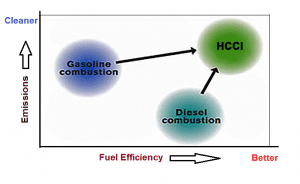
- Importance: Understanding auto-ignition through chemical kinetics helps in controlling knock in internal combustion engines, improving engine performance, and preventing engine damage. This is particularly important in high-compression engines and advanced combustion technologies like Homogeneous Charge Compression Ignition (HCCI).

Soot and Particulate Matter Formation
- Role: Soot formation occurs through complex chemical pathways involving hydrocarbon breakdown, nucleation of soot particles, and surface growth. Detailed kinetics allows for precise modeling of these pathways.
- Importance: Controlling soot is critical for reducing particulate emissions from combustion systems. Detailed kinetics helps identify key reaction steps in soot formation and suggests ways to modify combustion conditions to reduce soot production.
Optimization of Combustion Devices
- Role: By simulating the detailed kinetics of combustion, engineers can optimize the design of combustion devices such as gas turbines, furnaces, and internal combustion engines.
- Importance: Accurate kinetics allows for better predictions of combustion characteristics, helping optimize parameters like fuel injection, air-fuel mixing, and burner design. This leads to more efficient, reliable, and cleaner combustion devices.
High-Pressure and High-Temperature Combustion
- Role: In high-pressure and high-temperature conditions, reaction rates and pathways can change significantly, affecting combustion stability and emissions. Detailed kinetics helps model these conditions accurately.
- Importance: Understanding how combustion behaves at extreme pressures and temperatures is essential for applications such as aerospace propulsion, gas turbines, and industrial combustion systems, where efficiency and emissions control are critical.

Validation of Simplified Models
- Role: While detailed kinetics provides a comprehensive view, simplified or reduced kinetic models are often used in practical combustion simulations to reduce computational costs. Detailed kinetics is used to validate these reduced models.
- Importance: Validating simplified models with detailed kinetics ensures that the reduced models capture the essential features of combustion while remaining computationally feasible for large-scale simulations.
Challenges of Using Detailed Chemical Kinetics
- Computational Complexity:
- Detailed kinetic models can involve hundreds of species and thousands of reactions, leading to large computational requirements.
- This makes them challenging to implement in large-scale simulations or real-time applications.
- Model Uncertainty:
- Chemical reaction mechanisms are often based on experimental data, and for complex fuels, there may be uncertainties in the reaction pathways or rate constants, leading to challenges in accurate predictions.
- Time-Scale Issues:
- Chemical reactions occur on a wide range of time scales, from fast radical formation to slower fuel oxidation.
- Accurately capturing all these scales in a simulation can be computationally demanding.
Conclusion
- Detailed chemical kinetics is crucial for understanding and predicting combustion behavior, from fuel decomposition to pollutant formation.
- It plays a vital role in optimizing combustion systems for efficiency, performance, and emissions control.
- Despite the computational challenges, the use of detailed kinetics enhances the reliability of combustion models and is key to advancing cleaner and more efficient combustion technologies.